
Independent guidance for family homes
Solar PV for homes in Slovakia: a practical guide
Find out whether solar suits your home, which system and size to choose, its real cost after support and what installation, connection and operation involve. Independent information with dated figures and sources.
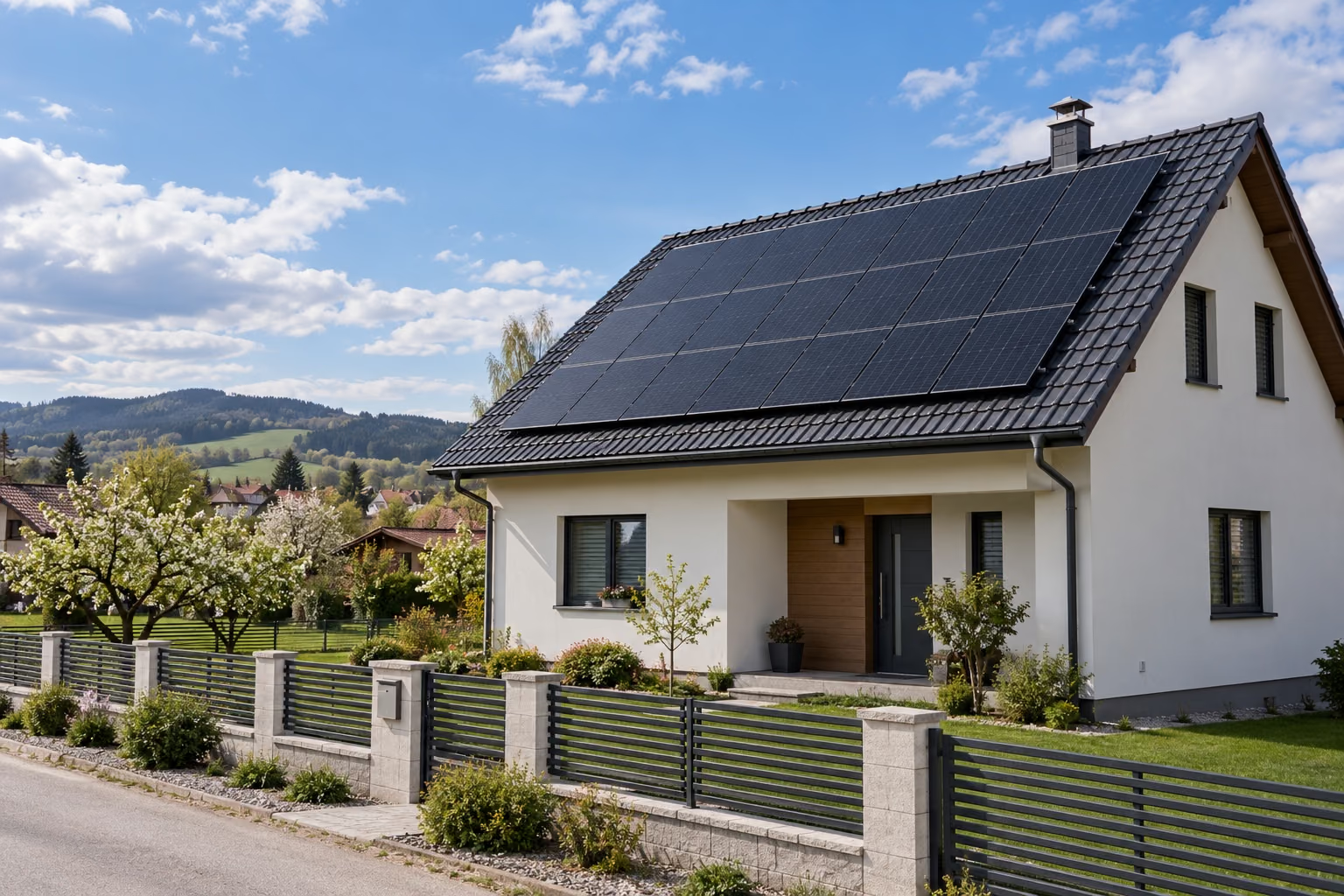
Solar PV in Slovakia in four figures
1,160–1,205 kWh
approximate annual generation per kWp on a south-facing roof
Model estimate for Košice through Bratislava, with a 35° tilt. Details
€6,450 – €10,999
examples of installed 5–10 kWp system prices
Seven public offers from three sellers, including VAT, before support. Details
up to €1,000
Zelená domácnostiam II contribution
€500 per kW, support for at most 2 kW and at most 50% of expenditure. Details
26. 10. 2026
registration opens at 13:00
Reservation requests from 2 November 2026 at 13:00 Slovak time. Details
Prices are examples of specific offers, not a market average. Generation is a model estimate rather than a measurement. Checked 21 October 2026.
What is solar PV, and what does FVE mean?
Photovoltaics converts sunlight directly into electricity. Solar photovoltaic panels on the roof produce direct current. The inverterconverts it into alternating current used by household appliances. The complete installation is called a photovoltaic system or photovoltaic power installation, commonly abbreviated FVE in Slovak. Official documents may also describe domestic PV as an electricity-generating source or a small source.
You will keep seeing two units. kWp (kilowatt-peak) is panel power under standard test conditions; it describes the rated size of the array. kWh (kilowatt-hour) is an amount of generated or consumed electricity, the same unit used on your bill. A 5 kWp system does not deliver 5 kW continuously: annual kWh depend on location, orientation and weather.
Electricity not used immediately can be exported, stored in a battery or used for water heating. The financial result depends strongly on how much generation actually replaces electricity purchases in your home.
Five decisions on the way to solar
Work through them in this order. Each step below explains the decision and links to a detailed guide.
- Is your home suitable?Roof, orientation, shade and when you use electricity.
- System type and powerWithout storage, with a battery or off-grid. Choosing useful kWp.
- Price and supportComplete installation cost and the Zelená domácnostiam contribution.
- Buying, installation and connectionCompare offers and complete the distribution approval process.
- OperationGeneration, surplus, virtual batteries, maintenance and winter.
1 Is your home suitable for solar?
Three major factors are roof direction, shading and when you use electricity. South-facing roofs generate the most in these models. East or west produces roughly a fifth less in the PVGIS comparison, but can still be useful and shifts more generation towards morning or evening. PVGIS
| City | South | East | West |
|---|---|---|---|
| Bratislava | 6,023 | 4,723 | 4,679 |
| Banská Bystrica | 5,863 | 4,639 | 4,535 |
| Košice | 5,803 | 4,590 | 4,504 |
PVGIS 5.3, 35° tilt, 14% losses, city-centre positions and long-term 2005–2023 weather. The model excludes nearby chimney, building and tree shadows. With panels on both east and west roofs, array capacity is divided between the two. PVGIS
Beyond orientation, assess the condition and structural capacity of the roof. SKSI explains that structure, wind and snow loading, fire safety and electrical design require separate assessment; panel weight alone is insufficient. SKSI If the roof needs replacement in a few years, address that before installing panels.
Finally, consider consumption timing: the annual bill total is not enough. When electricity is used matters, as SIEA also recommends. SIEA guide A household cooking, washing or heating water during the day can use more rooftop generation directly than one whose demand starts mainly in the evening.
For a flat, cabin or business, see the guides to balcony solar · solar for cabins · business solar.
Read more: Is your roof suitable for solar?Panel orientation and tilt
2 Which system and power should you choose?
Three broad configurations are relevant:
- Grid-connected without a battery (on-grid). The simplest and least costly arrangement; unused production goes to the grid under the agreed conditions.
- A system with a battery (hybrid). A suitable inverter coordinates panels and storage so some daytime generation can be used later. Certain inverters can add a supported battery later.
- An independent system (off-grid) without a grid connection. Usually more relevant to a cabin without a connection than a standard connected home.
Our hourly PVGIS reference calculation for Bratislava illustrates demand timing: 5 kWp and annual household use of 6,000 kWh. Without storage, it covered 56% of demand in the daytime-heavy profile and 24% in the evening-heavy profile. A 10 kWh usable battery raised coverage to 77% and 67%, respectively. PVGIS These profiles are assumptions rather than measured households. They illustrate a principle, not your savings.
Choose array power from demand, roof space and intended uses such as hot water, a heat pump or an electric car. The grant supports at most 2 kW, but that is a support cap rather than a recommended installation size. Support conditions The distributor decides the permitted connection and export for the actual property; see step 4.
A virtual battery is not physical storage. It is a contractual service from an electricity supplier such as ZSE, SSE, SPP or VSE, crediting surplus under its price list. It stores nothing at home and provides no outage supply. How virtual batteries work.
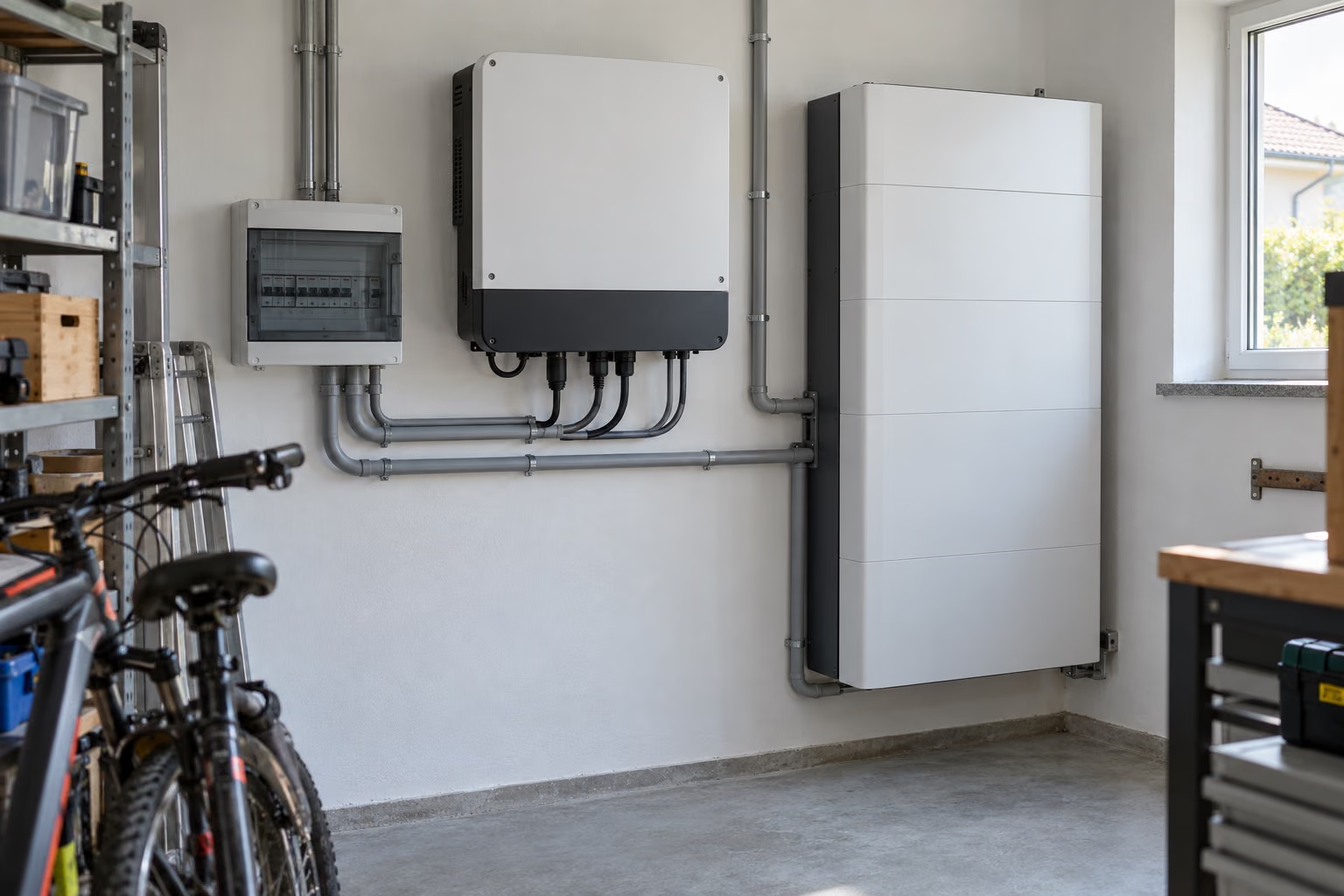
Read more: Grid-connected solar without a batterySolar with storage and hybrid systemsSolar batteries: capacity and selectionSolar invertersChoosing solar panelsLiFePO4 batteriesOff-grid solarChoosing solar system power
3 Solar cost and household support
A precise price depends on the roof, cable lengths, switchboard condition and scope. For context, these are public installed-system offers checked on 21 October 2026:
| Seller | Array power | Battery | Price |
|---|---|---|---|
| SolarGO | 5.0 kWp | not specified | €6,458 |
| EnergyInvest | 5.225 kWp | no battery | €6,450 |
| EnergyInvest | 5.225 kWp | 16 kWh (nominal) | €8,650 |
| SolarGO | 8.26 kWp | not specified | €7,750 |
| EnergyInvest | 9.975 kWp | no battery | €8,400 |
| EnergyInvest | 9.975 kWp | 16 kWh (nominal) | €10,600 |
| Energovision | 10.165 kWp | 10.36 kWh (nominal) | €10,999 |
These are seven configurations from three sellers, not a market average or endorsement. Scope varies: Energovision lists design, inspection and connection administration, while EnergyInvest addresses those items in an individual offer. Nominal storage capacity is different from usable capacity.
Zelená domácnostiam II support
From 21 October 2026 the new Zelená domácnostiam II conditions apply. PV receives €500 for each kW of supported power, counting at most 2 kW, giving a maximum of €1,000and no more than half of eligible expenditure. With the bonus conditions met, the rate is €575 per kW, up to €1,150. Support conditions Support rates
- Application registration opens on 26 October 2026 at 13:00 Slovak timeand reservation requests on 2 November 2026 at 13:00 Slovak time. Old applications are not transferred. SIEA
- After reservation confirmation, you have 45 calendar days for installation and a complete application; the deadline cannot be extended. SIEA
- You pay the full amount first; support follows installation, payment and approval. Panels and inverter must be on the eligible-equipment lists. Frequently asked questions SIEA inverter list
One unresolved point: the programme's equipment page still mentions systems up to 10.8 kW, while the new conditions do not contain that figure. Supported equipment Zelená solidarita for lower-income households has not activated new applications since 15 September 2026. A reopening date and revised conditions had not been found at the source-check date. Zelená solidarita SIEA decides support eligibility, rather than the seller.
Read more: Installed solar costs: all examplesSolar grants: conditions and applicationSolar calculatorIs solar worth it? Payback
4 Buying, installation and grid connection
Request several offers and compare the included scope. Ask about design, electrical inspection, the connection application, meter work, monitoring, exact equipment and usable battery capacity. For support, check programme eligibility and the ability to complete installation within 45 days of reservation confirmation.
Grid connection is handled by your distribution company, the regional network operator: ZSD in western, SSD in central and VSD in eastern Slovakia. This is distinct from your electricity supplier. Each has its own procedure:
- ZSD and SSD state that a draft agreement is sent within 10 working days of application; SSD requests a single-line diagram. ZSD SSD
- VSD accepts applications through eVSD and issues a statement within 10 working days of a complete application; the statement is valid for six months. VSD
- After installation come inspection, metering changes and the connection steps. Do not operate the system until the distributor confirms the connection.
A small-source connection being free does not mean export is unlimited. The distributor can set a low or zero export limit. All three published charges for exceeding agreed reserved capacity, MRK, from 1 January 2026. ÚRSO Building rules, distribution approval and grant conditions are separate matters requiring separate checks.
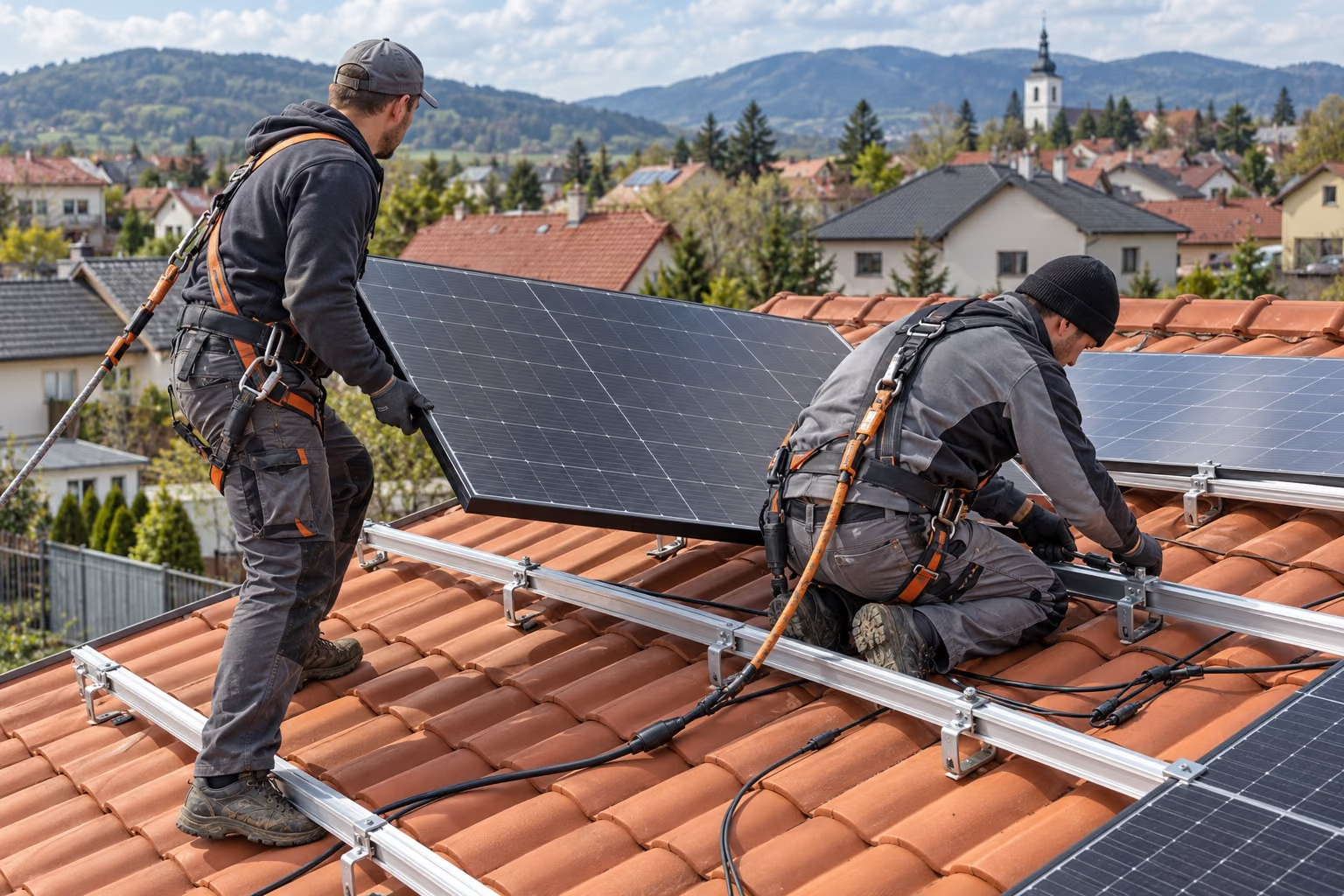
Read more: Solar installation step by stepComparing solar quotesChoosing a solar installerConnecting solar to the gridPermissions and legislation
5 Operating solar after installation
Existing owners face different questions from first-time buyers. Here are common tasks and where to start:
- Producing less than expected?
- Compare production with a model for the location and orientation rather than a summer maximum. Review the inverter or application regularly; a sudden drop without a weather change can indicate a fault. Investigating low production.
- Lower winter production
- This is expected. The Bratislava PVGIS model for 5 kWp gives about 195 kWh in December and 726 kWh in July. PVGIS Solar in winter.
- What should you do with surplus?
- Useful household consumption can replace imports: water heating, laundry and daytime car charging. Supplier virtual-battery services are another option; the cited examples list VSE at €3–€24 per month by volume and SPP at €3 per month VSE price list SPP price list. Other options include export sale or sharing with other consumption points through OKTE. OKTE Using surplus electricity. Electricity sharing.
- Adding a battery?
- Check support for the exact inverter/battery combination and the distributor's requirements. An inverter's SIEA listing concerns the support programme's lifetime requirement rather than distribution approval. SIEA inverter list Adding a battery.
- Maintenance and inspection
- Monitoring generation does not replace a professional check of electrical protection. Applicable electrical inspections must be carried out by an authorised inspector. SKSI Solar maintenance. Electrical inspections.
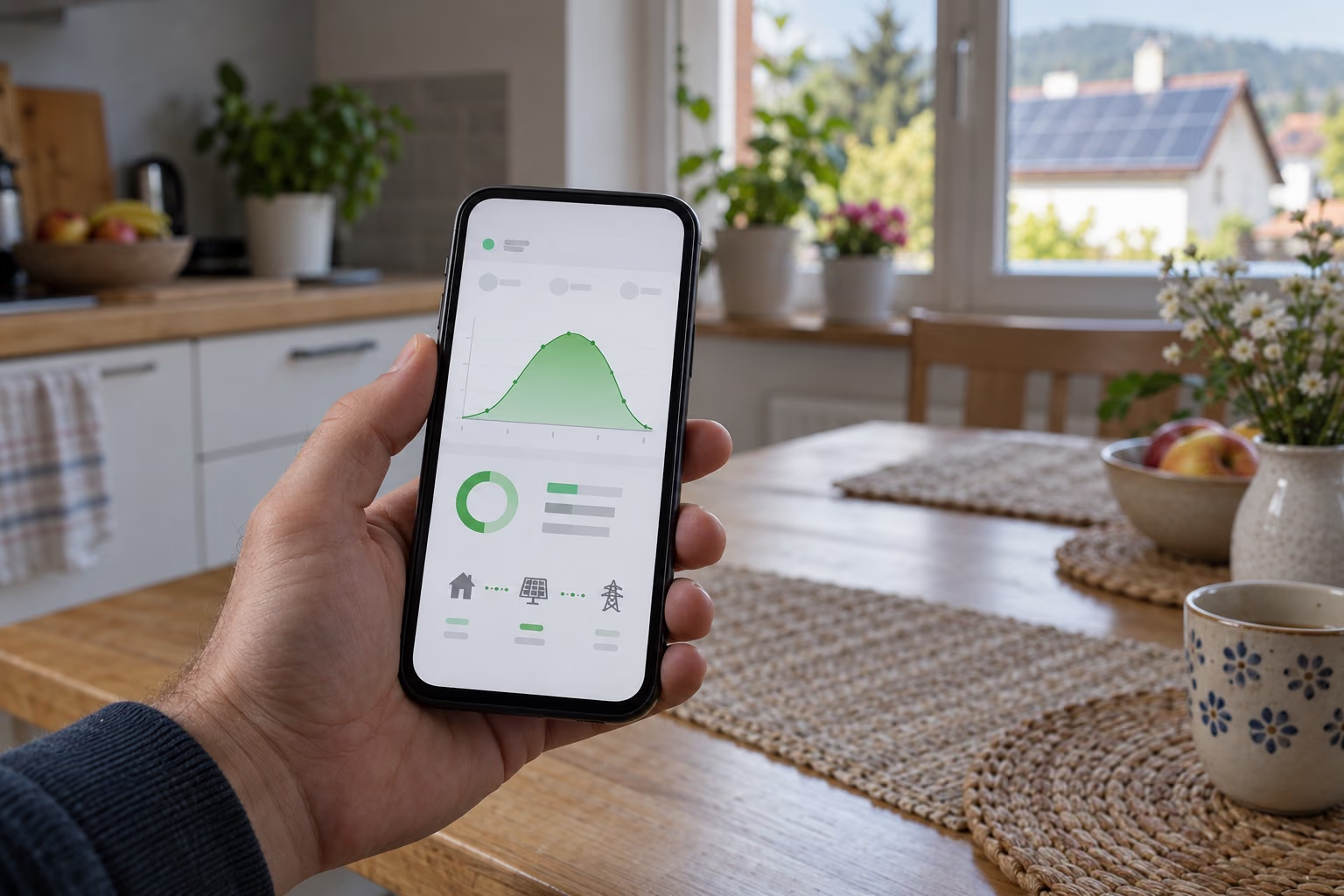
Read more: Solar monitoringDoes solar work during an outage?Virtual batteries
When solar may not pay
Solar is not a good investment for every home. Be cautious, or address the underlying problem first, in these situations:
- The roof is shaded much of the day or faces north. An unshaded-roof estimate will not describe its lower actual output.
- Very little electricity is used during the day and the plan depends on selling surplus. Export can be worth much less than imports cost. For example, the cited ZSE Flexi price for working days from 10:00 to 18:00 is €0.036/kWh excluding VAT, ZSE price list while the cited SPP variable import price is €0.16–€0.21/kWh including VAT, depending on region and entitlement to energy support. SPP price list
- The roof will need replacement soon. Removing and reinstalling panels adds costs.
- Buying storage for savingsdespite mainly daytime demand. In our example at assumed import/export prices of €0.18/€0.04 per kWh, the 10 kWh battery's annual benefit was roughly half as large for daytime-heavy demand as for evening-heavy demand. PVGIS
- The budget depends on a grantthat has not been confirmed. Reservations have ordering and deadlines, and payment follows installation.
PV does not remove fixed monthly electricity charges or distribution charges for energy still imported. Calculate payback from your bill and an actual offer rather than an advertised maximum saving. Calculating payback.
Fotovoltika or fotovoltaika?
Both Slovak words refer to the same technology and are used in practice. The Ľudovít Štúr Institute of Linguistics recommends fotovoltika and fotovoltickýas forms consistent with Slovak word formation; fotovoltaika follows the English word photovoltaics. JÚĽŠ SAV This site therefore uses fotovoltika. Also distinguish electricity-generating PV from solar thermal collectors that heat water. SIEA guide More on Slovak terminology.
Frequently asked questions
How much does solar PV cost for a family home?
Public offers checked on 21 October 2026quoted approximately 5 kWp installed at €6,450 to €6,458 and approximately 10 kWp at €8,400 without a battery, or with storage at €10,600 to €10,999including VAT and before support. These are examples from three sellers, not a market average; your quote depends on the roof, switchboard and work included.
How much electricity does 5 kWp of solar generate?
The PVGIS 5.3 model gives about 5,800–6,000 kWh annually for 5 kWp facing south at a 35° tilt, from Košice to Bratislava. East or west gives about 4,500–4,700 kWh. The model does not include nearby chimney or tree shadows.
What is the solar grant in 2026?
Under Zelená domácnostiam II, the contribution is €500 per supported kW, counting at most 2 kW: a maximum of €1,000and no more than half of eligible expenditure. If the bonus conditions are met, the rate is €575 per kW, up to €1,150. Payment comes after installation, payment of the invoice and application approval.
Do I need a solar battery?
Not necessarily. Storage helps when most demand occurs in the evening and at night. If you are home during the day or direct demand to water heating or a heat pump, the extra benefit is smaller. Some systems can add storage later if the exact inverter supports it.
Is a virtual battery the same as a physical battery?
No. A virtual battery is a contractual supplier service. You export surplus and receive credit under the supplier's conditions. Nothing is stored in your home, it provides no outage power, and distribution charges for imported electricity remain payable.
Does solar work during an outage?
A normal grid-connected system shuts down during an outage for safety. Supplying the home needs a supported hybrid inverter, battery and actually connected backup circuits. A hybrid inverter alone does not guarantee backup; include it explicitly in the offer.
Does solar generate in winter?
Yes, but much less. The Bratislava PVGIS model for 5 kWp gives about 195 kWh in December and 726 kWh in July. Plan for greater winter grid imports, including when considering storage or heating.
Do I need permission for solar?
Grid connection needs an application to the distributor and completion of its approval and connection process before operation. Building rules, co-owner consent, support and taxation are separate questions. One rule claiming that nothing is needed below a certain kW cannot cover them all.